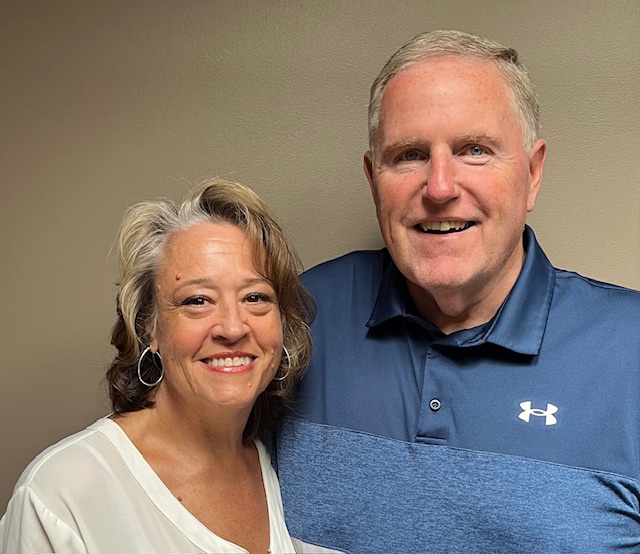
By Jeff & Mary Anne Woofter
The Power of Positivity in the Fight Against Chronic Disease
If you’ve followed our journey through Life with the Parkinheimers, you probably know by now that Mary Anne and I make an interesting pair. We’ve been together since high school, married for more than 42 years, and yet in some ways we couldn’t be more different.
Take our outlooks on life, for instance. Mary Anne has always been the “glass half full” type. She sees possibilities, hope, and sunshine where most people might only notice shadows. I, on the other hand, lean toward the “glass half empty” view. My natural tendency is to worry, analyze, and sometimes brace for the worst. Over the years, this difference has led to more than a few spirited debates at our kitchen table. But it’s also given me a front-row seat to something powerful: the incredible effect that a positive outlook can have, especially when facing chronic illness.
We’ve already written about depression and the importance of seeking help when it strikes, and believe me, that’s a subject close to both of our hearts. But today I want to focus on something different. I want to talk about the everyday power of choosing positivity, even when life hands you Parkinson’s, Alzheimer’s, or any other heavy burden.
Researchers have studied the effects of attitude on health for decades, and the results are eye-opening. While a positive outlook isn’t a magic cure, it does influence how our bodies and minds handle illness. Positivity has been linked to lower stress levels, stronger immune responses, improved cardiovascular health, and even better recovery from surgery or injury.
But beyond the medical studies, there’s the simple truth that positivity changes how we experience our days. A positive person is more likely to notice the small joys, a grandchild’s laugh, a sunset after a long day, the kindness of a friend who checks in. They don’t ignore the struggles, but they don’t let those struggles define every moment either.
Mary Anne, with her steady optimism, models this beautifully. She walks into every treatment, every doctor’s visit, every new challenge with an “it is, what it is” attitude. And while some might mistake that phrase as resignation, I’ve learned it’s actually the opposite. For her, it means: I accept what’s here, and I’m going to face it with grace and humor, not despair.
Living with Parkinson’s and Early Onset Alzheimer’s is no picnic. Everyday tasks, things I once did effortlessly, like shaving or getting out of the car, are now battles requiring patience and grit. Mary Anne has her own challenges, from memory lapses to fatigue. And yet, I’ve watched how our attitudes can either weigh us down further or lift us up, even in the same exact circumstances.
For example, let’s talk about something as ordinary as spilling a cup of coffee. If I’m in my “glass half empty” mode, the coffee spill feels like the universe mocking me, another reminder that my tremor is in control. I mutter, I cuss, and my mood sours for the rest of the morning. But Mary Anne? She laughs. She’ll grab a towel, mop it up, and make a joke about needing to buy stock in paper towels. Her laughter has this way of diffusing my frustration, turning what could have been a dark cloud into just a small, shared moment in the day.
Positivity doesn’t erase the coffee spill. It doesn’t give me steady hands again. But it does change the emotional weight of the moment, and when you’re dealing with chronic illness, those little shifts matter more than you’d think.
Now, I should be clear: positivity doesn’t mean wearing rose-colored glasses or pretending everything is wonderful when it’s not. That’s not realistic, and it’s not healthy. What I’ve learned from Mary Anne is that true positivity is rooted in acceptance and choice.
Acceptance says: Yes, this is hard. Yes, this diagnosis is real. Yes, some days will be ugly.
Choice says: But I can still choose how I respond. I can still choose to smile. I can still choose to notice beauty, kindness, and hope.
This balance, honesty about the struggle, but determination to keep looking for good, is what makes positivity powerful instead of shallow.
Another thing I’ve noticed is how contagious positivity can be. When Mary Anne walks into the infusion center for her Alzheimer’s treatments, she doesn’t just show up quietly and take her seat. She comes with a box of donuts for the nurses (and whoever just happens to walk in every other Tuesday), a cheerful word for other patients, and a smile that seems to brighten the whole room.
She could walk in with fear or sadness, and no one would blame her. But instead, she chooses to bring joy. And that choice ripples out. The staff feel it. Other patients feel it. I feel it.
Positivity, in that sense, is less about “thinking happy thoughts” and more about creating an atmosphere where hope can breathe, even in difficult spaces.
Mary Anne and I balance each other out. Her positivity challenges my natural pessimism, and my cautious outlook sometimes grounds her optimism. Together, we’ve found a rhythm that helps us walk this road without losing ourselves.
If you’re like me, the “glass half empty” type, let me offer a piece of encouragement: you don’t have to suddenly transform into a bubbly optimist to benefit from positivity. Small steps make a difference. Start by noticing one thing each day that you’re grateful for. Or when frustration rises, pause and ask: What would it look like to approach this with humor instead of anger?
And if you’re like Mary Anne, the “glass half full” type, don’t underestimate the gift you bring to others. Your light helps guide those of us who struggle in the dark.
Chronic illness can take away a lot: abilities, routines, independence. But it doesn’t have to take away joy. It doesn’t have to take away laughter. And it doesn’t have to take away the ability to face each day with courage, even if that courage looks different than it used to.
Mary Anne has taught me that positivity isn’t just a personality trait, it’s a discipline. It’s a daily choice to see hope, to extend kindness, and to hold onto joy. And in the battle against diseases like Parkinson’s and Alzheimer’s, that choice may be one of the strongest tools we have.
So here’s to half-full glasses, to laughter in the middle of coffee spills, and to the power of choosing positivity, even when life gives us every reason not to.
Because at the end of the day, attitude doesn’t cure the disease. But it sure makes the journey a whole lot lighter.