House of Delegates – District 1
(This opportunity for the House candidates to bring their views to our readers was extended to both candidates, Del. Pat McGeehan (R) and Quincy Wilson (D). Mr. Wilson did not respond despite several reminders while Del. McGeehan’s response follows.
Candidate:
Pat McGeehan
Home Address:
532 River Street
Chester, WV 26034
Party Affiliation:
Republican
Age:
46
Occupation:
Dean of Students, Madonna High School (Weirton, WV)
Reason for seeking the House of Delegates position:
I have the ability to do good for our home, and, in the main, that’s why I serve. I keep that orientation when I’m in Charleston.
Major legislative goal if elected:
There are always the more practical things that must be kept up with—like the upkeep of our roadways and other basic infrastructure. The state can often struggle or lack a proper motivation to maintain. So, by different ways, I try to provide makeup for that deficit in motivation. Beyond the practical, though, there’s also the longer-term problems that must be anticipated. One of these is also a problem the rest of the country needs to confront, as well: If birthrates continue to fall, our communities will become, essentially, ghost towns within just one generation or so. How we confront this, that’s ultimately the “64-million-dollar question.” The solution cannot be entirely reduced to simply more wealth. If that were true, the United States—the wealthiest country in the world—would also not have a low national birthrate. So, while the low national birthrate is roughly on par with West Virginia’s, the overall problem stands to disproportionately impact our state here in West Virginia sooner…and much harder.
While not the whole answer, more material goods is part of it. But, I think our youth must be given not just economic, material opportunities—but opportunities with real purpose and meaning behind them. For example, encouraging younger generations to master a trade or a craft can help teach the classical virtues such as prudence and self-control. And as I write this, I’ll be traveling to Washington, DC in the morning, to meet with the Secretary of Defense about funding a project that will create a 4-year military college in West Virginia (one similar to VMI or the Citadel). I’m hopeful ideas like this will come to fruition soon, which can give more opportunities to our up-and-coming kids—and attract others from around the country to our state. Such institutions can help instill in the younger generations a sense of obligation and service to our home going forward.
Our elderly need support as well. One thing I’d like to do is provide more choices for people with respect to how the funding for long-term care is spent. I think intergenerational family life is very important yet often overlooked. For various reasons, many of our people simply lack the time and finances to keep their parents or grandparents at home as they age. All too often, these constraints leave them with only one realistic option. So rather than leaving a nursing home as the only available option, we should try to give families more real choices to keep their parents or grandparents at home. Giving more control over the funding decisions behind long-term care could help with this. If families want to keep their own elderly at home—those that sacrificed for us—we should make it a priority to sacrifice for them, by giving their sons and daughters access to resources to care for them.
Do you feel the HOPE Scholarship has been a benefit or a detriment to our educational system?
The hope scholarship needs to be reformed. I think it’s become evident that parts of the program are being used inappropriately, especially when it comes to online curriculum for non-traditional education. However, the principle of keeping essential decisions in the hands of the parents is, generally, a fair one to operate from…when these reforms get done next year. Irrespective of this, the problems in our educational system are only symptomatic of deeper problems that need to be addressed. Namely, declining birthrates (which is spelled out in the previous question).
Do you feel Hancock County was/is being treated fairly in the State takeover of our school system?
The state takeover of our local school system was a tragedy. It was likely necessary in the short term, however, in order to stave off a more total insolvency. But the state’s direct management over local education has to be temporary…as the state’s intervention can be a double-edged sword. On the one hand, immediate, pressing decisions needed to be made about the financial problems facing our school district. Fortunately, the legislature passed funds for Hancock County schools to make payroll and continue operating. In one way or another, those funds were only granted on the condition that new management administers them. Some kind of trust had to be re-established with the taxpayers. Once the local school budget is balanced, though, the state needs to leave—and return local control to our people, for in the long term, the state can approach our people like numbers on a spreadsheet—for sometimes all they can see from Charleston is efficiencies. So, I think a realistic goal is to certify that the local school budget is balanced within roughly a year. If this can be done, it might force the state to concede that they’ll leave as soon as it can be demonstrated that the local financial problem (the state’s stated reason for the intervention in the first place) is no longer a problem.
What do you believe is our major priority to move Hancock County forward?
Well, I don’t think the way forward is found in the planned enterprise that is intent on burying 40 million tons of carbon dioxide gas every year, below our state park at Tomlinson Run. There doesn’t seem to be much “good” in this. In fact, there may be risks—risks not worth taking. No one from the company which plans to do this seems to be capable of relaying why they plan to do it—or to what end. It’s unfortunate how this came about. I plan to introduce a bill in January that would ban this practice of carbon sequestration at scale.
What is your position on locating data centers near our communities?
I think “data centers” should be approached by the particular circumstances surrounding each case. I certainly don’t think we should become Loudoun County, Virginia…where data centers now virtually litter the entire rural countryside. They reflect a force that has to be dealt with, however. And in so doing, we should ensure proper constraints—keeping them to limited areas, such as older industrial sites, and making sure they compensate for any demands they place on our local infrastructure and our power grid.
Any other comment/priority you’d like to share?
I appreciate the confidence the people of our home have granted me. I will keep doing my best not to let them down.
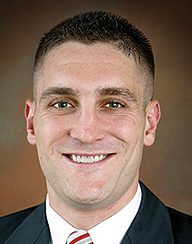
Pat McGeehan is the Majority Leader of the West Virginia House of Delegates. He is a graduate of Oak Glen High School and the US Air Force Academy in Colorado Springs. Pat served as a Military Intelligence Officer, including a tour of duty in the Middle East. He has published three books, including Printing Our Way to Poverty and Stoicism and the Statehouse, which became a bestseller, reaching #1 in the Leadership category on Amazon.
Pat currently serves in his third year as Dean of Students at Madonna High School, where he teaches courses in history, philosophy, and political science. He holds a Bachelor’s degree in history from the Air Force Academy, a Master’s degree in philosophy from Franciscan University, and a PhD in philosophy from Duquesne University.
Pat is a lifetime member of the Veterans of Foreign Wars and attends church at Sacred Heart in Chester and Saint Joseph’s in Weirton. He is the son of the late Colonel Mark McGeehan and Jodie (McIntosh) Juszczak. Pat resides in his hometown of Chester with his pride and joy—his daughter, Kennedy—as well as Kennedy’s kitten, Alexander, who joined the family last Christmas.